
A standard kitchen countertop is typically 25 inches deep from the front edge to the back, fitting over a standard 24-inch deep kitchen cabinet base.
The depth of your kitchen countertops is a crucial element in how functional and comfortable your kitchen workspace is. It dictates how much room you have for prep, how easily you can reach items, and how well your appliances fit. While “standard” sizes exist, there’s also room for customization to suit your specific needs. Let’s delve into the details of kitchen counter depth and related dimensions.
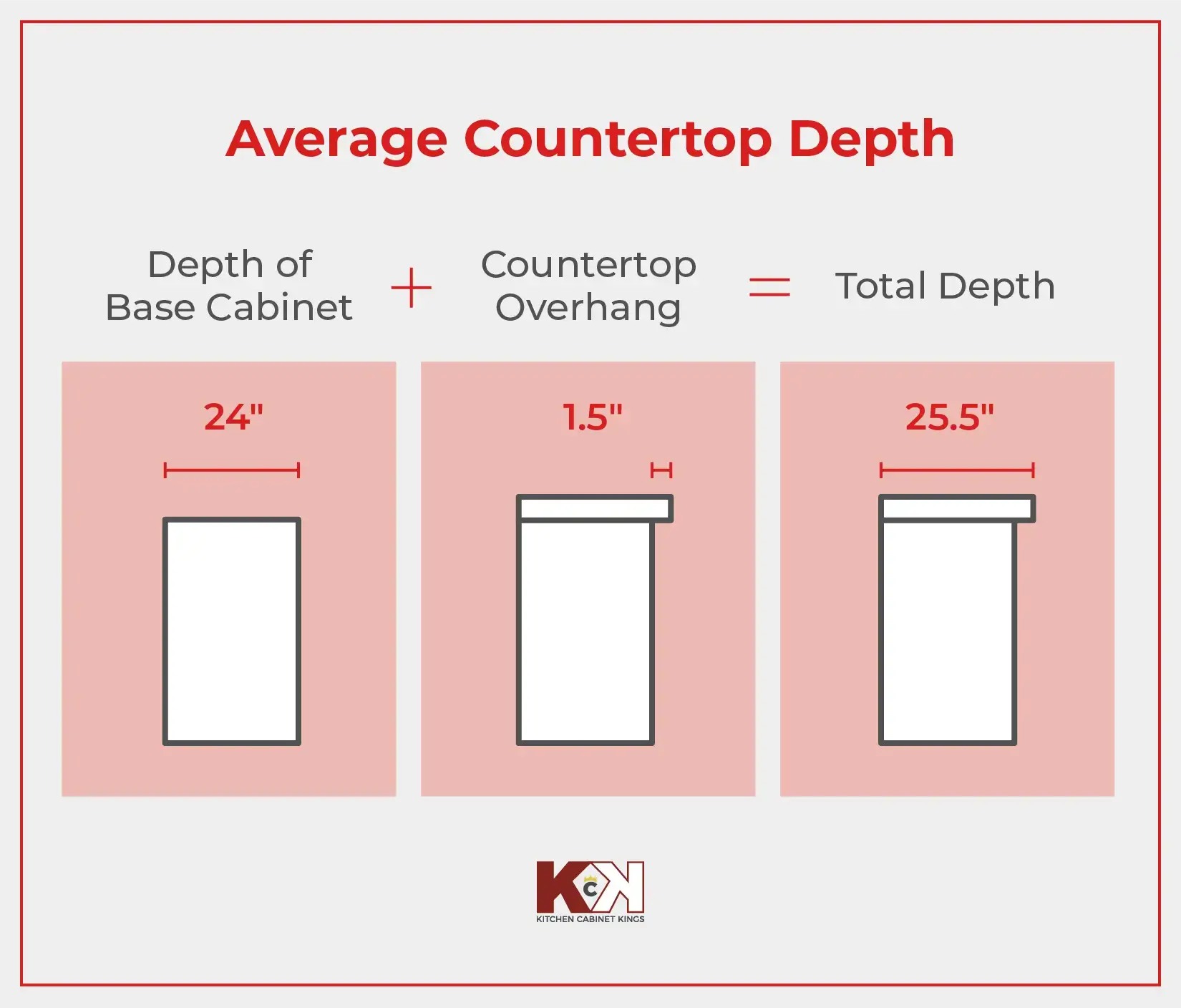
Image Source: cdn.kitchencabinetkings.com
Deciphering Standard Kitchen Countertop Dimensions
When we talk about a “standard” kitchen countertop, we’re usually referring to the most common dimensions found in kitchens across North America. This standard is largely driven by the dimensions of the kitchen cabinets they sit on.
Key Standard Dimensions:
- Standard Kitchen Countertop Depth: 25 inches. This measurement typically includes the countertop material itself plus a standard counter overhang.
- Standard Kitchen Cabinet Depth: 24 inches. This is the depth of the cabinet box itself, from the front of the cabinet face to the back of the cabinet box.
The extra inch in countertop depth (25 inches vs. 24 inches) accounts for the counter overhang. This overhang is a vital design element that serves multiple purposes.
The Purpose and Significance of Counter Overhang
The counter overhang is the portion of the countertop that extends beyond the face of the cabinet base. It’s not just for aesthetics; it has practical implications for usability and safety.
- Knee Clearance: The overhang provides essential knee space when you are standing at the counter to chop vegetables, mix ingredients, or even eat at a breakfast bar. Without it, your knees would constantly bump into the cabinet doors or drawers.
- Aesthetics: An overhang adds visual balance and a finished look to the countertop. It makes the countertop appear less like a simple flat surface and more like a deliberate design feature.
- Protection: The overhang helps protect the cabinet fronts from spills and splashes. If you spill something on the counter, it’s more likely to drip off the overhang than down the face of your cabinets, which can be harder to clean and potentially damage the finish.
Standard Counter Overhang: Typically, a standard kitchen counter overhang is 1 inch to 1.5 inches. So, a 25-inch deep countertop on a 24-inch deep cabinet base with a 1-inch overhang is a very common configuration.
Factors Influencing Countertop Depth
While 25 inches is standard, several factors might lead to different countertop dimensions.
1. Kitchen Cabinet Depth Variations
Although 24 inches is the most common cabinet base depth, you might encounter or choose other depths.
- Shallower Cabinets: In smaller kitchens or specific layout situations, you might find or opt for shallower cabinets, perhaps 18 or 21 inches deep. This would necessitate a shallower countertop depth to maintain a consistent overhang.
- Deeper Cabinets: Some custom or specialty cabinets might be deeper than 24 inches, especially if they are designed to house larger appliances or offer more storage. In these cases, the countertop would need to be correspondingly deeper.
2. Countertop Material Thickness
The thickness of your countertop material can slightly impact the overall depth, especially when considering the overhang. A thicker material might appear more substantial and can influence the perceived depth. However, the primary measurement of depth is from the front edge to the back plane of the countertop.
3. Ergonomics and Workspace Depth
The effective work surface depth is what matters most for usability. A standard 25-inch countertop provides a good balance for most tasks.
- Prep Space: This depth allows ample room for chopping boards, mixing bowls, and other preparation essentials.
- Appliance Fit: Many standard countertop appliances, like toasters, coffee makers, and blenders, fit comfortably within this depth, leaving some usable space in front of them.
- Reachability: It generally allows for comfortable reach to the backsplash area without excessive leaning.
4. Customization and Special Needs
For some individuals or specific kitchen designs, deviations from the standard are common.
- Enhanced Prep Areas: Chefs or avid home cooks might prefer a deeper work surface for more extensive preparation tasks. A 30-inch or even 36-inch deep countertop can significantly increase your usable kitchen workspace dimensions.
- Appliance Integration: If you’re installing a built-in appliance that is deeper than standard, your countertop will need to accommodate it. For example, a deeper range or a specialized cooktop might require a deeper counter.
- Accessibility: For individuals with mobility challenges, wider and deeper countertops can offer better access and usability.
Kitchen Countertop Depth in Relation to Other Dimensions
It’s helpful to see how countertop depth fits within the broader context of kitchen design and cabinet dimensions.
Standard Kitchen Cabinet Depths:
| Cabinet Type | Standard Depth | Typical Range | Notes |
|---|---|---|---|
| Base Cabinet | 24 inches | 23-25 inches | The box depth; countertop sits on this. |
| Wall Cabinet | 12 inches | 10-18 inches | Mounted on the wall; depth varies based on purpose. |
| Pantry Cabinet | 12-24 inches | 12-30 inches | Depth depends on storage needs and kitchen layout. |
Standard Kitchen Countertop Dimensions:
| Countertop Feature | Standard Dimension | Notes |
|---|---|---|
| Depth | 25 inches | Includes standard overhang; fits over 24-inch cabinets. |
| Thickness | 1.5 to 2 inches | Common thickness for granite, quartz, solid surface. Varies by material. |
| Length | Varies greatly | Determined by kitchen layout, cabinet runs, and design. |
| Height | 36 inches | Standard working height from floor to countertop surface. |
The Role of Cabinet Base Depth
The cabinet base depth is the foundation upon which the countertop rests. It’s essential to choose the right cabinet depth to support your desired countertop dimensions and overall kitchen functionality.
- Support: Deeper cabinets provide more robust support for heavier countertop materials like granite or quartz.
- Storage: Deeper cabinets offer more internal storage space, which is often a primary consideration for homeowners.
- Appliance Niche: Standard appliances, like dishwashers and ranges, are designed to fit within the 24-inch cabinet depth, with some allowance for the countertop overhang.
Customizing Cabinet Depths
While 24 inches is the norm, consider these scenarios for different cabinet depths:
- 18-inch Deep Cabinets: Often used in smaller kitchens or as secondary prep areas. Countertops would typically be around 19-20 inches deep.
- 20-inch Deep Cabinets: A compromise for smaller spaces where full 24-inch depth isn’t feasible. Countertops would usually be 21-22 inches deep.
- 30-inch Deep Cabinets: Less common for standard base cabinets, but might be used for specialized furniture-style islands or where maximum storage is paramount. Countertops could be 31-32 inches deep.
Understanding Kitchen Countertop Depth in Different Kitchen Zones
The ideal kitchen counter depth can vary slightly depending on its location and intended use within the kitchen.
Main Prep Area
This is typically the largest expanse of countertop, often located between the sink and the range. It requires ample work surface depth for chopping, mixing, and plating. The standard 25 inches is generally sufficient, but those who do a lot of cooking might wish for more.
Sink Area
Countertops around the sink need to be functional for dishwashing and food preparation. The standard depth usually accommodates most sinks comfortably, with enough space to work without feeling cramped.
Range Area
Similarly, the counter space around the range is crucial for placing hot dishes, ingredients, and utensils. The depth is important for safety and ease of use.
Breakfast Bar / Peninsula / Kitchen Island
These areas often have different depth requirements due to their dual purpose: as a workspace and a seating area.
Standard Kitchen Island Depth: Kitchen islands can have varying depths. A common depth for the cabinetry portion of an island is still 24 inches. However, the countertop depth can be significantly greater to accommodate seating.
- Seating Overhang: For comfortable seating, a counter overhang of 12 to 15 inches is recommended. This allows diners to sit with their legs under the counter without hitting the cabinet doors or drawers.
- Total Island Depth: Therefore, an island countertop might be 36 to 40 inches deep or even more if it incorporates appliance niches or additional storage. The cabinet base might still be 24 inches, with the remaining depth dedicated to the seating overhang.
Calculating Your Countertop Depth
To determine your ideal countertop depth, consider these points:
- Cabinet Base Depth: Start with the depth of your chosen or existing cabinet base depth.
- Appliance Requirements: Factor in any built-in appliances that need to fit within or alongside the countertop.
- Task Needs: Think about the primary tasks you perform in that area. Do you need a lot of space for prep?
- Ergonomics: Consider your height and reach. A slightly deeper counter might be more comfortable for taller individuals, while a shallower one might be easier to reach across for shorter individuals.
- Seating Requirements: If the countertop is part of an island or peninsula intended for seating, ensure adequate overhang.
Formula for Total Countertop Depth:
Cabinet Base Depth + Counter Overhang = Total Countertop Depth
Example:
24 inches (Cabinet Base Depth) + 1 inch (Counter Overhang) = 25 inches (Standard Countertop Depth)
Example for Island Seating:
24 inches (Cabinet Base Depth) + 15 inches (Seating Overhang) = 39 inches (Total Island Countertop Depth)
Common Countertop Materials and Their Impact on Dimensions
The material you choose for your countertops can sometimes influence the practical dimensions, especially concerning thickness and edge profiles.
- Granite & Quartz: Typically available in 2cm (approx. 0.75 inches) and 3cm (approx. 1.25 inches) thickness. Thicker slabs can create a more substantial look and may support larger overhangs without additional bracing.
- Marble: Similar to granite and quartz, often available in 2cm and 3cm thickness. It requires careful consideration of support for overhangs due to its porous nature.
- Solid Surface (e.g., Corian): Can be fabricated in various thicknesses and is often joined seamlessly. It can often support larger overhangs than stone without visible seams or supports.
- Laminate: Usually has a plywood or particleboard core with a decorative laminate layer. Standard thickness is around 1.5 inches, and overhangs are generally limited to prevent bowing.
- Butcher Block (Wood): Available in various thicknesses, from 1.5 inches up to 4 inches or more. Deeper, thicker butcher block can make for stunning and functional work surfaces, especially on islands.
While the material thickness is part of the overall countertop dimensions, it’s the front-to-back measurement that defines the worktop depth.
Maximizing Your Kitchen Workspace Dimensions
Achieving the most effective kitchen workspace dimensions involves more than just the depth of your counters.
- Layout: The overall kitchen layout (e.g., galley, L-shape, U-shape) significantly impacts how you use the space.
- Appliance Placement: Strategic placement of appliances can create better workflows and more usable counter space.
- Cabinetry Design: Drawer configurations, pull-out shelves, and corner solutions can optimize storage and accessibility within your cabinets.
- Lighting: Good task lighting makes even a standard depth feel more expansive and functional.
Increasing Work Surface Depth
If you find that a standard 25-inch depth is consistently limiting, here are ways to increase your work surface depth:
- Deeper Cabinet Bases: Opt for 27-inch or 30-inch deep cabinet bases. This will require custom cabinetry and may involve adjustments to standard appliance sizes or clearances.
- Extended Countertop Overhang: Extend the countertop beyond the standard cabinet depth significantly. This is common for breakfast bars but can also be done for primary prep areas. Be mindful of structural support needed for large overhangs.
- Appliance Garage: Instead of having small appliances permanently on the counter, consider appliance garages that conceal them when not in use, freeing up valuable kitchen workspace dimensions.
- Wall-Mounted Shelving: For less frequently used items or decorative pieces, wall shelves can reduce the need to store them on the counter.
Practical Considerations for Countertop Depth
When planning your kitchen, always consider the practical implications of your chosen countertop depth.
1. Appliance Fit
- Ranges: Standard ranges are typically 24 inches deep, fitting neatly within a 25-inch countertop. However, some professional-style ranges can be deeper.
- Dishwashers: Most dishwashers are designed to be 24 inches deep and install flush with the front of the cabinet base.
- Refrigerators: Counter-depth refrigerators are designed to align with standard cabinetry, usually around 24 inches deep. Standard refrigerators are often deeper and will protrude past the countertop.
2. Walkways and Clearances
A deeper countertop can slightly reduce walkway space. Ensure that even with a deeper counter, you maintain adequate clearances for movement and safety, especially in high-traffic areas. A minimum of 36 inches for main walkways is generally recommended.
3. Backsplash and Wall Clearance
With a standard 25-inch countertop, there’s usually a few inches of space between the back of the countertop and the wall, allowing for a backsplash. If you opt for a deeper countertop, ensure you account for your backsplash material thickness.
4. Reach and Accessibility
For individuals of shorter stature, a very deep countertop might make it challenging to reach the backsplash or the back of the counter. Conversely, very tall individuals might find a standard depth a bit low. Ergonomic considerations are key.
Frequently Asked Questions About Kitchen Countertop Depth
Q1: Can I have a custom depth for my kitchen countertops?
A1: Yes, absolutely! While 25 inches is standard, custom depths are readily available from most countertop fabricators and cabinet makers. You can choose a depth that perfectly suits your needs, whether it’s for more prep space or to accommodate specific appliances.
Q2: What is the minimum depth for a kitchen countertop?
A2: While there isn’t a strict minimum mandated by building codes for all areas, for functional prep space, a minimum of around 20-22 inches is often considered, especially in smaller kitchens where space is at a premium. However, 25 inches is the standard for good reason.
Q3: How does countertop thickness affect its overall depth?
A3: Countertop thickness is added to the structural support (like a cabinet box). The “depth” measurement refers to the front-to-back dimension of the countertop slab itself. So, a 3cm thick granite slab on a 24-inch cabinet with a 1-inch overhang will result in a 25-inch total depth. The thickness itself doesn’t change the fundamental depth measurement but contributes to the overall visual and structural presence.
Q4: What is the recommended counter overhang for seating?
A4: For comfortable dining or seating at a kitchen island or peninsula, a counter overhang of 12 to 15 inches is recommended. This provides enough knee clearance. For more casual seating or bar stools, 10 inches might suffice, but 12 inches is generally more comfortable.
Q5: What are the dimensions of a standard kitchen island?
A5: A standard kitchen island usually starts with a base cabinet depth of 24 inches. The countertop depth can vary significantly depending on whether it includes seating. An island with just cabinetry might have a 25-inch deep countertop. An island with seating typically has a countertop depth of 36-40 inches or more to accommodate the necessary counter overhang for seating.
In conclusion, while a standard kitchen countertop is typically 25 inches deep, designed to fit over a 24-inch deep cabinet base with a 1-inch overhang, this dimension is not a rigid rule. By considering your kitchen’s layout, your cooking habits, and the appliances you use, you can customize your kitchen counter depth to create the most functional and enjoyable work surface depth for your home. Always factor in the essential counter overhang for usability and aesthetics to achieve the best kitchen workspace dimensions.