
The standard kitchen countertop height is 36 inches from the floor to the top of the counter. Can you have different kitchen counter heights? Yes, custom heights are possible and often chosen for ergonomic or aesthetic reasons.
Designing a kitchen is about more than just picking pretty cabinets and appliances. It’s about creating a space that works for you. A crucial, yet often overlooked, element is the height of your countertops. The perfect countertop height can make cooking, prepping, and cleaning a breeze, while an awkward height can lead to strain and discomfort. This guide will delve deep into kitchen counter height, exploring the standard dimensions, why they exist, and the many options available to suit your needs and style.
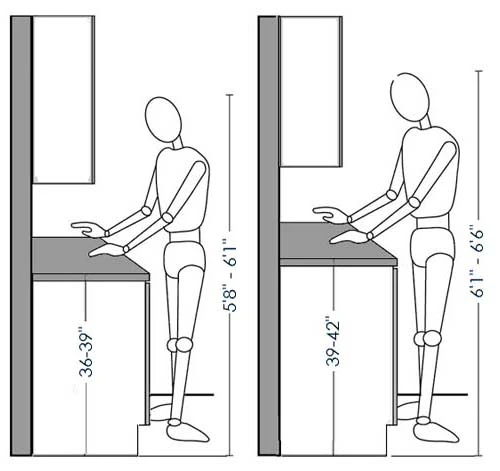
Image Source: www.regattaexports.com
The Foundation: Standard Kitchen Counter Height
For decades, the 36-inch standard has been the benchmark for kitchen counter height. This height was largely established in the mid-20th century as kitchen designs became more standardized and manufacturers began producing cabinets and countertops in consistent sizes.
Why 36 Inches?
The 36-inch height isn’t arbitrary. It’s a carefully considered measurement that balances the needs of the average adult.
- Ergonomics for Most: This height generally allows most adults to stand comfortably while working, chopping vegetables, mixing dough, or washing dishes. It promotes a relatively neutral posture, minimizing strain on the back and shoulders.
- Appliance Compatibility: Standard base cabinets, which support the countertops, are typically 34.5 inches tall. When combined with a standard 1.5-inch countertop thickness, this results in the 36-inch finished height. This standardization also ensures that common appliances like dishwashers and ovens fit seamlessly underneath.
- Work Surface for Various Tasks: The 36-inch height provides a good balance for a variety of kitchen tasks. It’s high enough to prevent excessive bending for many people, yet low enough to allow comfortable reach for most common kitchen tools and appliances.
Deciphering the 36-Inch Standard
Let’s break down what contributes to this widely adopted height:
- Base Cabinet Height: Most manufactured base cabinets come in a standard height of 34.5 inches. This is without the countertop.
- Countertop Thickness: The countertop material itself adds to the overall height. Common countertop thicknesses range from 1.5 inches to 2 inches. When a 1.5-inch thick countertop is added to a 34.5-inch base cabinet, the total height becomes 36 inches.
This simple addition creates a consistent and predictable work surface for the majority of users in a typical kitchen.
Beyond the Standard: Exploring Other Heights
While 36 inches is the norm, the ideal kitchen counter height can vary significantly based on individual needs and preferences.
Ergonomic Kitchen Counter Height: Tailoring to You
Ergonomics is the science of designing the workplace to fit the worker, not the other way around. In the kitchen, this translates to countertop heights that minimize physical strain and maximize comfort.
Fathoming Your Ideal Height
The ideal ergonomic countertop height is often cited as being about 3-6 inches below your elbow when you are standing with your arms relaxed at your sides and your elbows bent at a 90-degree angle.
- For Tall Individuals: Taller people (over 5’10”) may find standard 36-inch countertops too low, leading to back strain. Increasing the countertop height by 2-4 inches can make a significant difference in comfort and reduce bending.
- For Shorter Individuals: Shorter individuals (under 5’4″) might find standard countertops a bit too high, requiring them to reach uncomfortably. A slight reduction in height, perhaps to 34 or 35 inches, could be more comfortable.
- For Specific Tasks: Some tasks might benefit from different heights. For instance, a dedicated baking station might be slightly lower for easier kneading, while a chopping area might be slightly higher to reduce bending.
Creating an Ergonomic Workflow
Consider these points when aiming for an ergonomic kitchen:
- Measure Yourself: Stand naturally and have someone measure from your elbow to the floor. Subtract 3-6 inches to find your optimal countertop height.
- Trial and Error: If possible, test out different heights using temporary props before committing to a custom solution.
- Zone Your Kitchen: Different zones might have slightly different heights. For example, a primary prep area might be ergonomically adjusted, while a secondary area remains standard.
Accessible Kitchen Counter Height: Designing for All
In today’s diverse world, accessibility is a paramount consideration. This means creating kitchens that can be comfortably and safely used by people of all abilities, including those who use wheelchairs.
ADA Standards and Kitchens
The Americans with Disabilities Act (ADA) provides guidelines for accessible design. For kitchen countertops, this often means providing a lower section.
- Minimum Height: The ADA recommends an accessible counter height of 34 inches maximum. This allows individuals using wheelchairs to comfortably roll underneath.
- Knee Space Clearance: Crucially, accessible countertops require adequate knee space clearance. This typically means a clear floor space and a minimum of 27 inches of clear knee space from the floor to the underside of the counter.
- Reach Ranges: ADA guidelines also specify forward and side reach ranges, ensuring that controls and appliances are within easy reach from both standing and seated positions.
Implementing Accessible Features
- Partial Lowering: You don’t need your entire kitchen to be at an accessible height. A common approach is to have a section of the countertop, perhaps in a key prep area or on an island, lowered to 30-34 inches.
- Cabinet Modifications: This often involves using specialized accessible base cabinets that provide the necessary knee space and clearance.
- Roll-Under Sinks: Accessible sinks are designed to allow wheelchair users to roll underneath, often featuring shallower basins and specialized plumbing to avoid obstructing knee space.
Custom Kitchen Counter Height: Unleashing Your Vision
The beauty of renovating or building a new kitchen is the freedom to customize. A custom kitchen counter height allows you to tailor the space precisely to your needs and aesthetic.
Factors Influencing Custom Heights
- User’s Height: As discussed with ergonomics, this is the primary driver.
- Specific Appliances: Some built-in appliances might have specific height requirements that dictate countertop placement.
- Design Aesthetics: Sometimes, a particular design vision might call for non-standard heights to create visual interest or a unique flow.
- Combination of Users: If multiple people of significantly different heights use the kitchen, you might consider tiered countertops or multi-level islands.
When to Consider Custom Heights
- Significant Height Differences: If household members have very different heights.
- Specific Medical Needs: For individuals with back issues or other physical limitations.
- Unique Design Goals: To achieve a specific look or functionality.
- Multi-Generational Households: To accommodate elderly or younger family members comfortably.
The Depth and Width of Your Countertops
While height is critical, the standard kitchen counter depth and width also play vital roles in kitchen functionality.
Standard Kitchen Counter Depth
The standard kitchen counter depth is 24 inches. This dimension is measured from the front edge of the countertop to the back, where it meets the backsplash or wall.
Why 24 Inches?
- Appliance Integration: This depth is designed to accommodate standard base cabinets (typically 24 inches deep) and allow for the flush installation of common appliances like ranges, dishwashers, and refrigerators.
- Work Surface Area: 24 inches provides a substantial and practical work surface for food preparation, placing appliances, and holding utensils.
- Clearance: It leaves enough space between the countertop and the front of appliances for comfortable maneuvering and opening oven doors.
Considerations for Depth
- Deeper Counters: Some kitchens opt for deeper countertops, such as 30 inches, especially for islands or peninsulas. This offers more workspace and can accommodate bulkier appliances or serve as a more generous gathering spot. However, deeper cabinets can impact aisle clearance.
- Shallow Counters: In very small kitchens where space is at a premium, you might see slightly shallower countertops, but this can compromise workspace and appliance integration.
Standard Kitchen Counter Width
The standard kitchen counter width is less about a fixed dimension and more about the length of the cabinet run. Standard base cabinets come in various widths, typically in 3-inch increments, ranging from 12 inches to 48 inches.
Planning for Width
- Cabinet Modules: Kitchen layouts are built using these modular cabinet widths. The overall counter width is simply the sum of the widths of the cabinets installed in a row.
- Visual Balance: The width of countertops, especially on islands or peninsulas, should be balanced with the overall kitchen size and layout to avoid overwhelming the space or creating awkward traffic flow.
Kitchen Islands: More Than Just Countertop
Kitchen islands have become a staple in modern kitchens, serving as prep areas, dining spots, and social hubs. Their height, depth, and width can all be customized.
Kitchen Island Height
Kitchen island height can follow the standard 36 inches, or it can be varied for specific purposes.
- Standard Height (36 inches): This is common if the island primarily functions as an extension of the main kitchen counter for prep work and general use.
- Bar Height Countertops (42 inches): Many islands incorporate a raised bar section, typically at 42 inches, to accommodate seating. This allows for casual dining or a place for guests to chat with the cook.
- Counter Height Table (30 inches): Some islands feature a lower section at dining table height (around 30 inches) for more formal dining or crafting.
- Multi-Level Islands: Combining different heights on an island offers versatility. For example, a 36-inch prep area could transition into a 42-inch bar.
Island Depth and Width
- Depth: Island depths can range from 24 inches (for a basic work surface) to 36 inches or even more if incorporating seating with an overhang or appliances.
- Width: The width of an island depends heavily on the kitchen’s size and layout. It needs to be wide enough to be functional but not so wide that it impedes movement.
Table: Common Kitchen Island Configurations
| Feature | Typical Height | Purpose | Seating Capability |
|---|---|---|---|
| Standard | 36 inches | Prep, extra workspace | Limited (if any) |
| Bar Height | 42 inches | Casual dining, socializing | Yes |
| Dining Height | 30 inches | Dining, crafting, project work | Yes |
| Multi-Level | Varied | Combines multiple functions | Yes |
Countertop Installation Height: Precision Matters
The final countertop installation height is a critical step that ensures everything is level, secure, and at the intended measurement.
The Installation Process
- Cabinet Placement: Base cabinets are installed first, ensuring they are level and securely fastened to the walls.
- Leveling: Shims are used to fine-tune the cabinet height and ensure a perfectly level surface for the countertop. This is crucial, especially for stone or solid surface materials, to prevent cracking or unevenness.
- Countertop Placement: The countertop is then carefully placed onto the cabinets.
- Securing: Countertops are typically secured from underneath by screwing through the cabinet face frames into the countertop material. For heavier materials like granite or quartz, adhesive is often used in addition to mechanical fasteners.
Ensuring Correct Height During Installation
- Accurate Measurements: Double-check all measurements before and during installation.
- Level Foundation: Ensure cabinets are perfectly level.
- Professional Installation: For complex materials or custom heights, professional installation is highly recommended to guarantee a flawless finish and the correct final height.
Material Considerations and Height
While the structural cabinets dictate the base height, the thickness of your chosen countertop material can subtly influence the final measurement.
Common Countertop Thicknesses
- Laminate: Typically 1.5 inches.
- Solid Surface (e.g., Corian): Often 0.5 inches or 1 inch thick, with a built-up edge to achieve a thicker look, usually totaling 1.5 inches.
- Granite, Quartz, Marble: Commonly available in 1.25 inches (3 cm) or 2 cm thicknesses. For a standard 36-inch finished height, a 1.5-inch total thickness is often achieved by using a 0.75-inch slab with a wooden sub-base or a thicker slab with a built-up edge.
- Butcher Block: Can vary widely, from 1.5 inches to 4 inches or more.
Impact on Final Height
If your base cabinets are the standard 34.5 inches, a thicker countertop material will naturally result in a higher finished counter. For example:
- 34.5-inch cabinet + 1.5-inch countertop = 36-inch finished height.
- 34.5-inch cabinet + 2-inch countertop = 36.5-inch finished height.
Always factor in the countertop thickness when planning your desired final kitchen counter height.
Special Considerations and Trends
Beyond the standard, several special considerations and emerging trends are influencing countertop heights.
Bar Height Countertops and Counter Height Tables
These are particularly popular for islands and peninsulas, offering versatile dining and social spaces.
- Bar Height Countertops: At 42 inches, these are ideal for bar stools. They create a comfortable perch for casual meals, snacks, or drinks. The overhang for seating typically needs to be at least 10-12 inches for comfortable legroom.
- Counter Height Tables: These fall between standard counter height and bar height, often around 36 inches. They can be used with counter-height stools for a more integrated look or as a secondary workspace. The term “counter height table” often refers to a table designed to match the standard kitchen counter height.
Raised or Tiered Countertops
As mentioned, tiered countertops are a great way to incorporate multiple functionalities and ergonomic benefits into one space.
- Example: A main prep area at 36 inches, with a raised section at 42 inches for bar seating, and perhaps a slightly lower section at 30-33 inches for a specific task like baking.
Floating Countertops
These are countertops that appear to be suspended in mid-air, often attached to the wall with hidden brackets.
- Installation: Their installation height is entirely flexible, determined by the desired aesthetic and functionality. They can be installed at standard heights or any custom height.
- Support: The wall-mounted brackets must be robust enough to support the weight of the countertop material and anything placed on it.
Frequently Asked Questions (FAQ)
What is the standard kitchen counter height?
The standard kitchen counter height is 36 inches from the floor to the top of the counter.
Can I have different kitchen counter heights in my kitchen?
Yes, you can have different kitchen counter heights. Many people opt for custom heights for ergonomic reasons or choose to incorporate varying heights on kitchen islands.
What is the standard kitchen counter depth?
The standard kitchen counter depth is 24 inches.
What is the standard kitchen counter width?
The standard kitchen counter width is determined by the width of the base cabinets used in the layout, which are typically modular and come in standard increments.
What is the typical kitchen island height?
Kitchen island heights can vary, but 36 inches is common for a standard work surface. Islands can also be built at bar height (around 42 inches) for seating or at dining table height (around 30 inches).
How is countertop installation height determined?
Countertop installation height is determined by the height of the base cabinets, any leveling shims used, and the thickness of the countertop material itself. Precision during installation is key.
What is considered an ergonomic kitchen counter height?
An ergonomic kitchen counter height is typically around 3-6 inches below your bent elbow when standing. This can vary based on individual height and comfort.
What is an accessible kitchen counter height according to ADA guidelines?
According to ADA guidelines, accessible counter heights should be a maximum of 34 inches, with adequate knee space clearance underneath.
What are bar height countertops?
Bar height countertops are typically around 42 inches high, designed to accommodate bar stools for casual dining or socializing.
What is a counter height table?
A counter height table is a table that is the same height as standard kitchen countertops, typically around 36 inches.
Can I get custom kitchen counter height?
Yes, custom kitchen counter height is a popular option, especially for homeowners with specific ergonomic needs or unique design preferences.
By carefully considering these dimensions and options, you can create a kitchen that is not only beautiful but also a joy to work in, for yourself and for everyone who uses it.