
Can you deduct home office utilities? Yes, you can deduct home office utility costs if you use a portion of your home exclusively and regularly for business. How do you calculate these costs? You’ll need to determine the percentage of your home used for business and apply that to your total utility bills. This guide will help you figure out your home office utility costs and how to claim them.
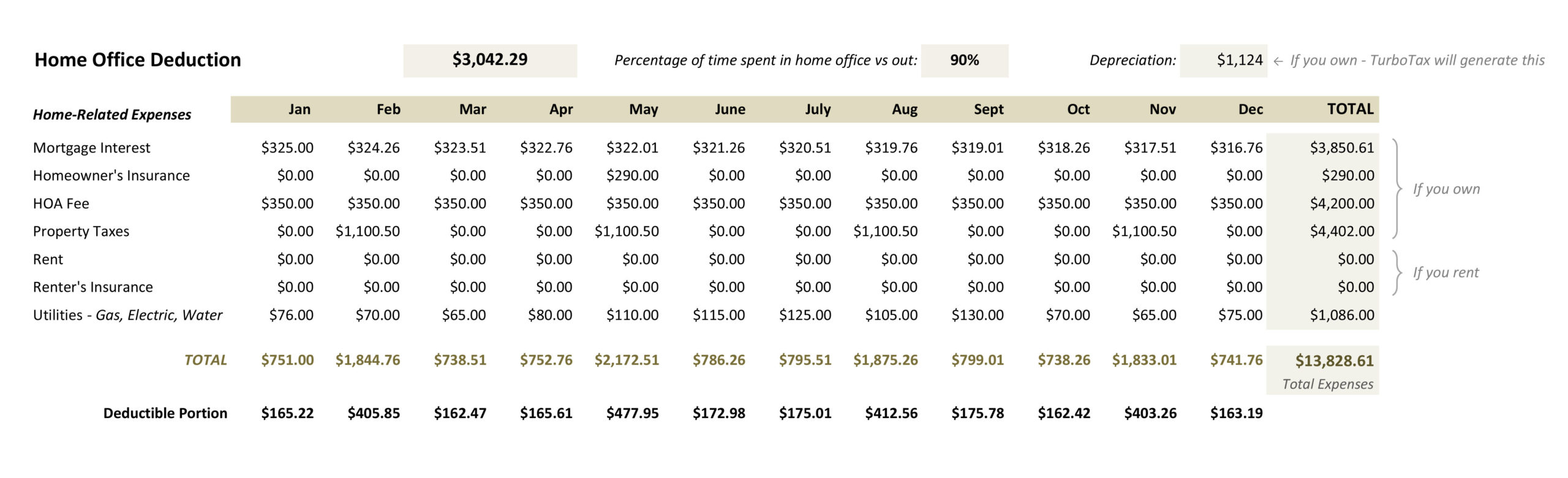
Image Source: linpernille.com
Calculating Your Home Office Utility Costs
Running a business from home offers flexibility, but it also means you’re responsible for a share of your household bills. Properly calculating home office expenses, especially deductible home office utilities, is crucial for maximizing your tax deductions. The key is to be accurate and consistent. We’ll walk you through how to determine your eligible utility expenses and claim them effectively. This includes figuring out your home office energy consumption and allocating utility bills fairly.
Determining Your Business Use Percentage
The first step in claiming residential utility costs for business is to establish the portion of your home dedicated to your business. The IRS allows two methods for this: the simplified option and the regular method.
The Simplified Option
This is a straightforward approach. You deduct a standard amount of $5 per square foot of your home used for business. The maximum square footage allowed is 300 square feet. This means the maximum deduction under the simplified option is $1,500 per year ($5/sq ft * 300 sq ft). This method is quick and requires less record-keeping for specific expenses. However, it might not capture the full amount of your actual home office operating costs.
The Regular Method
This method requires more detailed calculations but can often result in a larger deduction. It involves determining the square footage of your home used for business and comparing it to the total square footage of your home.
Formula:
(Square Footage of Home Office / Total Square Footage of Home) x 100 = Business Use Percentage
Example:
- Your home office is 150 square feet.
- Your total home is 1,500 square feet.
(150 sq ft / 1,500 sq ft) x 100 = 10% Business Use Percentage
This 10% is the figure you’ll use to allocate your home office utility costs and other home-related expenses.
Tracking Home Office Energy Consumption for the Regular Method
When using the regular method, you’ll need to track all your utility bills. This includes:
- Electricity
- Gas
- Water and sewer
- Trash removal
- Internet service
- Phone service
You’ll then apply your business use percentage to the total cost of these utilities for the year.
Table: Example Utility Calculation (Regular Method)
| Utility Type | Annual Cost | Business Use Percentage | Deductible Amount |
|---|---|---|---|
| Electricity | $1,200 | 10% | $120 |
| Gas | $600 | 10% | $60 |
| Water | $300 | 10% | $30 |
| Trash Removal | $240 | 10% | $24 |
| Internet | $720 | 10% | $72 |
| Phone | $480 | 10% | $48 |
| Total Deductible Utilities | $354 |
What Utilities Can You Deduct?
You can deduct a portion of the utilities that are essential for running your home and, by extension, your home office. These typically include:
- Electricity: For lights, computers, printers, and other electronic devices.
- Gas/Heating Oil: For heating your home office space.
- Water: For any necessary water usage within your home office.
- Trash Removal: A standard household expense that supports the operation of your home.
- Internet Service: Essential for most modern home businesses.
- Landline Phone Service: If you use a landline for business calls.
Important Note: Mobile phone plans are generally not deductible unless you have a separate business line or can specifically prove business usage.
Claiming Utility Expenses on Your Taxes
When you file your taxes, you’ll use Form 8829, Expenses for Business Use of Your Home, if you are using the regular method. This form helps you calculate your deductible expenses, including utilities. If you are self-employed and your business is a sole proprietorship, partnership, or LLC taxed as a sole proprietorship or partnership, you’ll report this deduction on Schedule C (Form 1040), Profit or Loss From Business.
Allocating Utility Bills
The process of allocating utility bills is straightforward once you have your business use percentage. You simply multiply the total cost of each utility by your business use percentage. For example, if your internet costs $70 per month and your business use percentage is 10%, you can deduct $7 per month ($70 x 0.10).
Home Office Energy Consumption Considerations
When considering home office energy consumption, it’s helpful to think about what contributes most to your bills. Lights, heating, and cooling are usually the biggest factors. While you can’t deduct the portion of these used for personal space, your business use percentage accounts for this.
Practical Tips for Tracking and Reducing Costs
- Keep Good Records: Save all your utility bills. Digital copies are fine, but ensure they are organized and accessible.
- Meter Readings: If possible, and if your home office has its own meter (unlikely for most residential setups), you could track exact usage. However, the business use percentage method is the standard for most.
- Energy Efficiency: Consider energy-efficient lighting and appliances. While not directly a utility deduction, reducing your overall consumption can lower your bills, thus reducing the amount you need to allocate.
- Thermostat Control: Adjust your thermostat when you are not working or when your office space is not in use.
Deductible Home Office Utilities and the Business Use of Home Deduction
The business use of home deduction allows you to deduct expenses related to maintaining and using a portion of your home for business. Deductible home office utilities are a key component of this deduction. It’s important to remember that the space must be used exclusively and regularly for your business. This means the area cannot be used for personal purposes. For example, using a corner of your living room when guests are over would disqualify it from exclusive use.
Exclusive Use Rule
This is a critical aspect. If you use a room as your office, but also use it for personal activities, you cannot deduct utilities for that entire room. If you have a dedicated office space within a room, you would need to calculate the business use percentage based on the square footage of that dedicated space, not the entire room.
Regular Use Rule
Your home office must be used on a regular basis for your business. Occasional use does not qualify.
Can I Deduct Utilities if I Work from a Co-working Space?
If you rent an office outside your home and also work from home, you generally cannot claim the business use of home deduction, including home office utility costs. The deduction is specifically for those who use their home as their principal place of business or as a place to meet clients.
Specific Utility Calculation Scenarios
Let’s delve into some specific scenarios to clarify the calculation process.
Scenario 1: Single Utility Bill for the Entire Home
This is the most common situation. You receive one bill for electricity, gas, water, etc., for your entire residence.
Process:
- Calculate Business Use Percentage: Determine the square footage of your home office and divide it by the total square footage of your home.
- Gather Total Utility Costs: Collect all your utility bills for the tax year.
- Apply Percentage: Multiply the total cost of each utility by your business use percentage.
- Sum Deductible Amounts: Add up the deductible portion of all your utilities.
Scenario 2: Dedicated Home Office Space with Separate Meter (Rare)
In some rare cases, a home office might have its own utility meter, such as a separate electrical meter for a workshop.
Process:
- Direct Usage: If you have a separate meter, you can directly deduct the full amount of the utility bill for that meter, as it solely serves your business.
- Shared Utilities: For utilities that serve the entire home (e.g., heating, water), you will still need to use the business use percentage to allocate the costs.
Scenario 3: Multiple Home Offices
If you have multiple distinct spaces within your home that you use exclusively and regularly for business, you can add the square footage of all these spaces together to calculate your total business use percentage.
Tracking Home Office Energy and Other Expenses for Maximum Benefit
Accurate record-keeping is paramount. For claiming utility expenses, keep copies of:
- Monthly utility bills.
- Proof of payment (bank statements, cancelled checks).
- Records of your home’s total square footage.
- Measurements of your home office space.
This meticulous approach ensures you can accurately calculate your home office operating costs and maximize your tax savings.
The Impact of Home Office Energy Consumption on Deductions
Your home office energy consumption directly influences the amount you can deduct for utilities. Higher usage naturally leads to higher bills. By implementing energy-saving practices, you not only reduce your environmental footprint but also lower the out-of-pocket expenses for your business.
Frequent Use vs. Exclusive Use
It’s vital to reiterate the difference between frequent use and exclusive use.
- Frequent Use: This means you use the space often.
- Exclusive Use: This means you use the space only for your business.
If you use your dining room table as an office during the day but eat meals there in the evening, you cannot deduct utilities for that space. It must be a dedicated area.
Allocating Utility Bills Fairly and Accurately
The goal of allocating utility bills is to assign the appropriate portion of shared costs to your business. The business use percentage method is designed to do just that. It’s a reasonable allocation that reflects the portion of your home’s resources your business consumes.
Claiming Utility Expenses Beyond the Basics
Beyond the core utilities, consider other expenses that might be deductible if they are essential for operating your home office:
- Homeowner’s Insurance: A portion can be deductible if it covers your business property or if it’s a general homeowner’s policy that you’re allocating.
- Homeowner’s Association (HOA) Fees: If applicable, a portion can be deductible.
- Home Repairs: If you repair the portion of your home used for business, that repair cost can be deductible.
What if My Home Office Isn’t a Separate Room?
If your home office is a designated area within a larger room (e.g., a desk in a corner of your bedroom), you must measure only that specific area used for business. If you use a partition or a specific piece of furniture to demarcate your office space, measure that area. The IRS requires that this area be clearly identifiable.
Common Pitfalls to Avoid
- Deducting 100% of Utilities: Unless your entire home is a dedicated business space (very rare), this is incorrect.
- Using the Wrong Square Footage: Be precise when measuring your home and office.
- Not Keeping Records: Without receipts and documentation, your deductions can be challenged.
- Deducting Personal Expenses: Ensure only business-related portions of your home expenses are claimed.
Residential Utility Costs for Business and Tax Laws
Tax laws regarding the business use of home deduction and deductible home office utilities can change. It’s always advisable to consult with a qualified tax professional or refer to the latest IRS publications (like Publication 587, Business Use of Your Home) to ensure you are compliant and claiming all eligible expenses.
Frequently Asked Questions (FAQ)
Q1: Can I deduct my entire internet bill if I use it for business and personal reasons?
A: No, you can only deduct the business portion. You would apply your business use percentage to the total internet cost. If you have a separate business line, that’s a different situation.
Q2: What if I only use my home office space occasionally?
A: The space must be used regularly for business. Occasional use does not qualify for the deduction.
Q3: Do I have to use the regular method for calculating home office deductions?
A: No, you have the option of using the simplified method ($5 per square foot, up to 300 sq ft). However, the regular method may allow for a larger deduction if your actual expenses are high.
Q4: If I switch from the regular method to the simplified method, can I switch back?
A: If you use the simplified method in one year, you generally cannot switch back to the regular method in a future year unless your circumstances change significantly, such as a change in the way you use your home for business.
Q5: Is there a limit to how much I can deduct for home office utilities?
A: Yes, your total home office expense deduction, including utilities, cannot exceed the gross income derived from your business use of your home, less your other business expenses. This means you cannot use home office deductions to create a net loss for your business.
Q6: What if I work from home for an employer, not for myself?
A: The rules for employees working from home have changed. For tax years 2018 through 2025, unreimbursed employee expenses, including home office expenses, are generally not deductible due to the Tax Cuts and Jobs Act. This applies to W-2 employees. If you are self-employed, these rules apply differently.
Q7: How do I handle electricity usage for my office equipment versus general home usage?
A: The business use percentage method simplifies this. You apply the same percentage to your total electricity bill. The IRS presumes that your business use percentage applies to all utilities shared by the household.
By carefully calculating and tracking your home office utility costs, you can ensure you are taking advantage of all eligible tax deductions, contributing to a more efficient and cost-effective home-based business operation.